


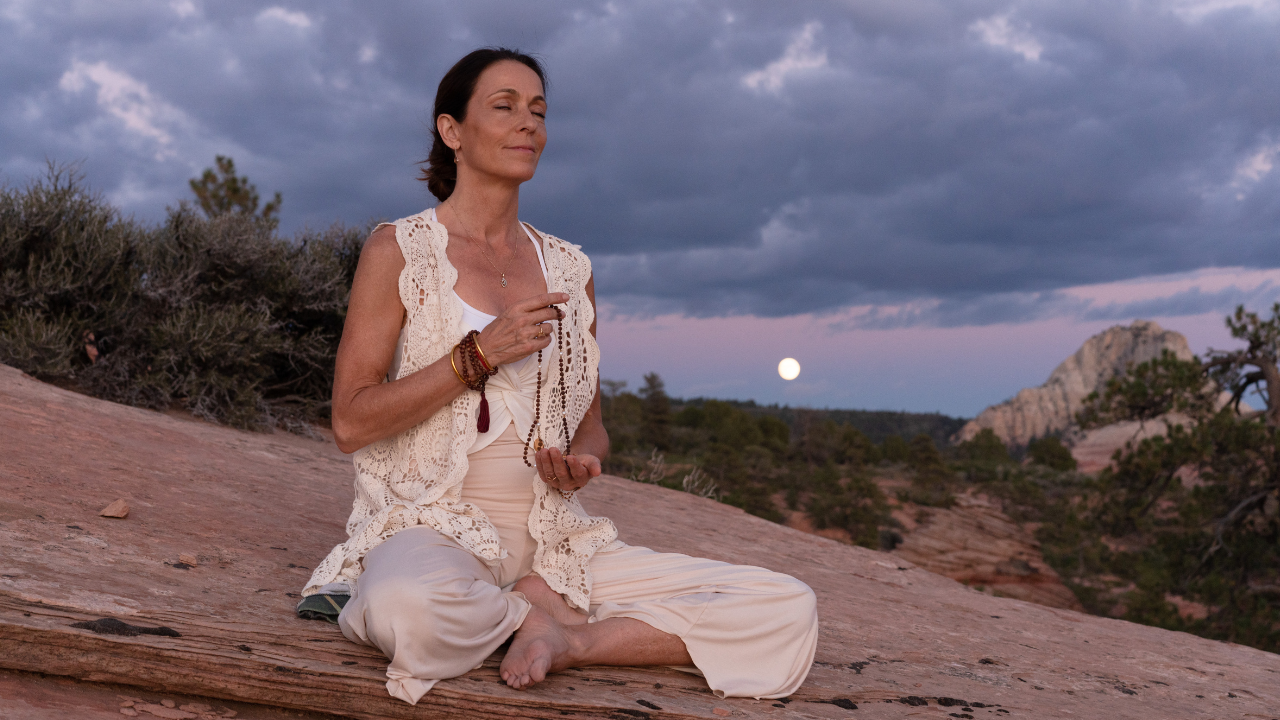
As I continue writing about the courage to see clearly, I find myself drawn toward a question that feels increasingly close to home.
Most of us who have walked a sincere spiritual path know what it is to give our heart to something, to a practice, a teaching, a teacher, a vision of what it means to live wisely. That wholehearted giving of ourselves is often how the deepest transformation begins.
Practice also asks us to grow. Part of that growth is learning to cultivate discernment along with our heartfelt devotion.
To me, devotion is an orientation of the heart toward what is most deeply true. Every sincere practitioner has felt it, that subtle pull to return to practice, not because of obligation or discipline alone, but because something within recognizes that each time we become still, something essential is remembered. Beneath the endless movement of thought there is another place from which we can live. We may only glimpse it at first, perhaps in a moment of meditation when everything briefly becomes quiet, or at the end of practice, when life suddenly feels whole again. Yet once we have touched it, however briefly, we find ourselves wanting to return. Devotion is born from those moments. It is the natural movement of the heart toward that which brings us closer to ourselves.
Alongside devotion, another quality begins to emerge. The sages called it viveka, discernment. As we continue to practice, we slowly become more attentive to our own experience. We begin to notice that some thoughts leave us contracted while others open us, that certain choices carry the unmistakable feeling of alignment while others diminish us. Life itself begins to teach us. We become less interested in arriving quickly at answers and more willing to remain close to what is genuinely unfolding. Discernment grows as our relationship with ourselves becomes more honest.
Perhaps nowhere is this relationship more beautifully expressed than between teacher and student.
In the beginning, it is natural for our devotion to flow toward someone who embodies a wisdom we long to discover within ourselves. A true teacher offers practices, asks questions, and helps us notice what we could not yet see alone. Their presence gives us courage to keep walking. Yet something equally beautiful is happening beneath the surface. With every practice, every moment of genuine insight, and unexpected clarity or stillness, we discover a deeper dimension of ourselves.
Gradually, the relationship changes. The teacher continues pointing in the same direction, yet the student is no longer looking only toward the teacher. They are learning to recognize the subtle intelligence awakening within their own experience. The outer guidance has begun fulfilling its deepest purpose by revealing an inner one.
I have often wondered if this is one of the greatest responsibilities we carry as teachers. Not simply to share knowledge, but to continually return students to themselves, to encourage the kind of practice that allows each person to discover, through direct experience, what no one else can ever give them.
This feels especially relevant in the time we are living through.
Many spiritual communities are finding themselves asking difficult questions as teachers, institutions, and traditions reveal aspects of themselves that had remained unseen. There is real grief, sadness, and disappointment, in discovering that someone we admired could not live up to our ideal.That grief deserves to be honored. And it can also become one of the most clarifying moments on the path, where we transcend personal attachment and shift our devotion to the inner Truth and experience that the tradition points us toward.
Where has my devotion been resting? Has it continued to deepen toward the living truth revealed through practice, or has it become attached to something, or someone, that was never meant to carry that weight?
These are tender questions. They are not asked to diminish the sacredness of the teacher-student relationship, but to honour it. It was always meant to awaken freedom, to invite us into a deeper intimacy with Truth than another person could ever embody on our behalf. This way we allow teachers to illuminate the path without asking them to become the source of our light.
In the end, devotion and discernment can mature together. The deeper our devotion to Truth becomes, the more willing we are to see clearly. And the clearer we see, the more naturally devotion arises, not toward personalities or beliefs, but toward Truth itself.
This is the maturation of the spiritual path. We can continue to bow with gratitude to those who have illuminated the way, while allowing the light they pointed toward to become our own place of orientation.
The path then asks something profoundly simple, and practical. How do we cultivate the clarity to remain faithful to that deeper knowing in the midst of an often noisy and reactive world?
This is what we explore in the upcoming essay The Inner Revolution.